


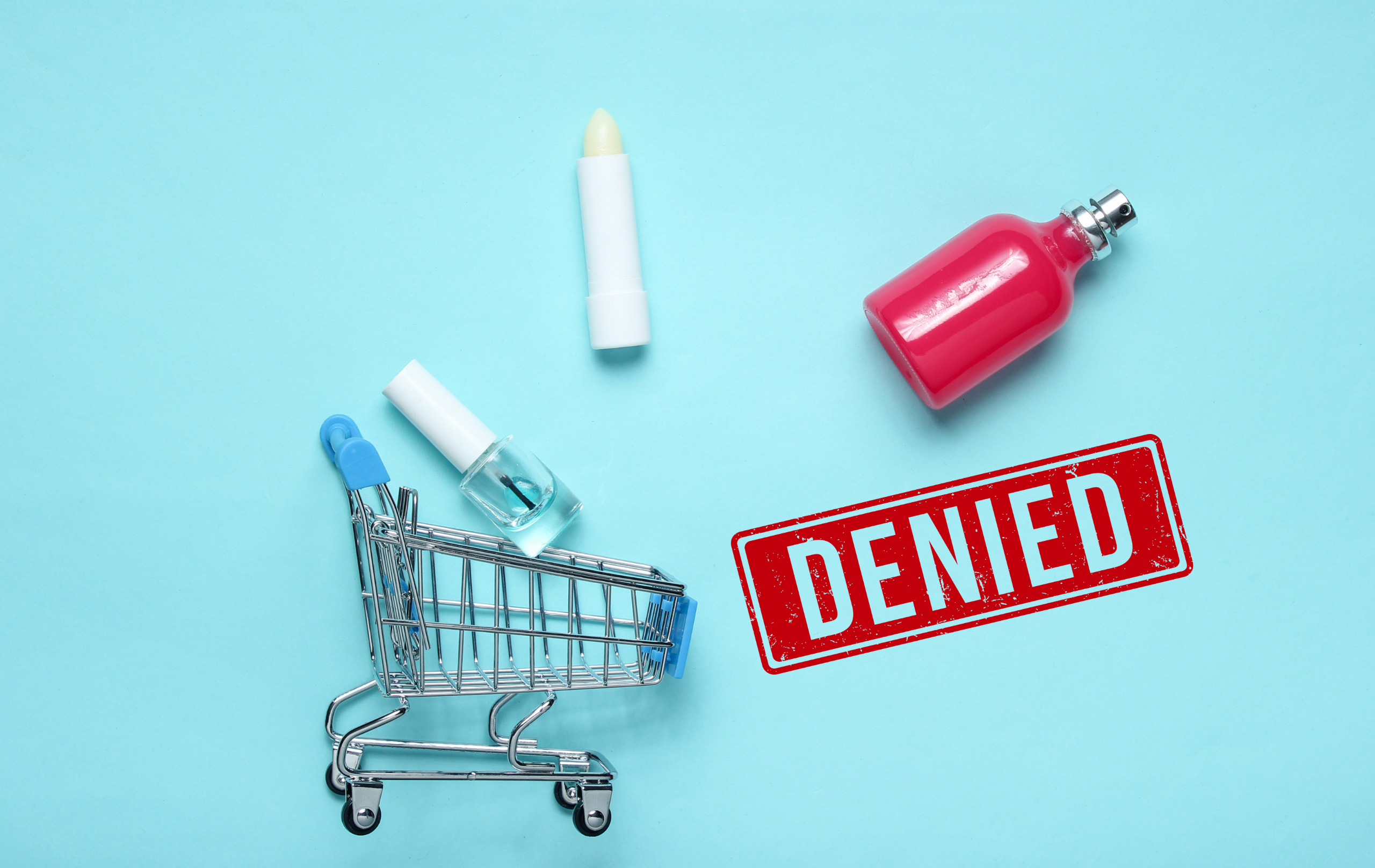
A cosmetic product may be rejected in its target market for many reasons, including formulation issues, labelling errors, incomplete safety documentation or incorrect product notification.
In highly regulated markets such as the European Union, the United Kingdom, the United States and Türkiye, even a seemingly minor compliance issue may delay market access or prevent the product from being placed on the market.
The answer to the question “Why was my cosmetic product rejected?” is rarely limited to a single issue. The Product Information File, ingredient list, product label, safety documentation and manufacturing processes may all need to be reviewed together.
Below are some of the most common reasons cosmetic products may face compliance issues or rejection, together with the areas companies should review.
1. The Product May Contain a Prohibited or Restricted Ingredient
Ingredients used in cosmetic products must comply with the regulatory requirements of the target market.
A product may face rejection or non-compliance if:
- It contains a prohibited substance.
- A restricted ingredient exceeds the permitted maximum concentration.
- An ingredient is used outside its permitted conditions of use.
- A preservative, colourant or UV filter is not authorised for the intended use.
- A new regulatory restriction affecting the ingredient has entered into application.
In the European Union, Annexes II, III, IV, V and VI of Regulation (EC) No 1223/2009 are particularly important when assessing cosmetic formulations.
Manufacturers should therefore assess each raw material not only by its INCI name, but also by its concentration, intended function and the type of cosmetic product in which it is used.
2. The Product Label May Not Meet Regulatory Requirements
Labelling errors are among the most common causes of cosmetic product non-compliance.
- Potential issues may include:
- Missing Responsible Person details.
- Incorrect or incomplete nominal content.
- Incorrect use of the date of minimum durability or Period After Opening (PAO) symbol.
- Missing batch or lot number.
- Unclear product function.
- Incorrect ingredient list order.
- Missing mandatory warnings.
- Mandatory information not being provided in the required local language.
Even where the product formulation is compliant, incorrect or incomplete labelling may prevent the product from being legally placed on the market.
3. The INCI List May Contain Errors
Ingredients used in a cosmetic product should be declared correctly in the ingredient list.
Common INCI-related errors may include:
- Using an incorrect INCI name.
- Listing the commercial raw material name instead of the required ingredient name.
- Listing ingredients in the wrong order.
- Failing to declare fragrance allergens separately where required.
- Incorrectly declaring colourants.
- Differences between the formulation and the ingredient list shown on the label.
A particularly common compliance issue occurs when the formula is updated but the product label is not revised accordingly.
4. The Cosmetic Product Safety Report May Be Incomplete or Insufficient
Cosmetic products placed on the European Union market require a Cosmetic Product Safety Report (CPSR).
Insufficient data supporting the product’s safety may delay or prevent completion of the compliance process.
Potential issues may include:
- Insufficient toxicological data.
- Missing raw material specifications.
- Missing microbiological quality data.
- Inadequate stability data.
- Failure to assess product-packaging compatibility.
- Incorrect exposure calculations.
- Additional information being requested by the Safety Assessor.
A cosmetic safety assessment involves more than reviewing the formulation.
The intended use, target user group, exposure level and packaging characteristics may also need to be considered.
5. The Product Information File May Be Incomplete
Under the EU Cosmetics Regulation, a Product Information File (PIF) must be maintained for the cosmetic product.
The PIF generally includes:
- A description of the cosmetic product.
- The CPSR.
- A description of the manufacturing method and a statement of GMP compliance.
- Evidence supporting the claims made for the product.
- Relevant information regarding animal testing.
An incomplete or outdated PIF may create significant compliance risks.
The PIF should also remain up to date for as long as required. Changes to the formula, manufacturing site, labelling or safety information may require corresponding updates to the documentation.
6. The Product Notification May Be Incorrect
Depending on the market, cosmetic products may need to be notified through the relevant regulatory system before being placed on the market.
For example, cosmetic products in the European Union must be notified through the Cosmetic Products Notification Portal (CPNP) before market placement.
Potential notification errors may include:
- Selecting the wrong product category.
- Uploading incomplete label information.
- Entering incorrect formulation information.
- Providing incorrect Responsible Person details.
- Incorrectly identifying product variants.
Completing a notification does not, by itself, demonstrate that a product is compliant.
The information submitted through the notification system should be consistent with the Product Information File and the actual product placed on the market.
7. The Responsible Person Requirement May Not Have Been Met
Cosmetic products placed on the EU market must have a Responsible Person established within the European Union.
The Responsible Person has responsibilities including:
- Supporting compliance with applicable regulatory requirements.
- Ensuring that the PIF remains accessible.
- Completing or managing product notification requirements.
- Communicating with competent authorities.
- Coordinating corrective measures where required.
Manufacturers established outside the EU that attempt to place products on the market without an appropriate Responsible Person may face delays, compliance action or restrictions on market access.
8. Product Claims May Not Be Adequately Supported
Marketing claims used for cosmetic products should not be misleading and should be supported by appropriate evidence.
Potentially problematic claims may include statements such as:
- “Treats disease”
- “Prevents disease”
- “Treats eczema”
- “Completely eliminates acne”
- “Treats hair loss”
Such statements may go beyond the expected function of a cosmetic product and could affect its regulatory classification.
Performance claims such as:
- “24-hour moisturisation”
- “90% smoother skin”
- “Clinically proven”
should also be supported by appropriate testing or other relevant evidence.
Unsupported claims, or claims that may change the regulatory classification of a product, can create significant compliance risks.
9. Microbiological Test Results May Be Unsatisfactory
Microbiological safety is particularly important for cosmetic products containing water.
A product may raise safety concerns if it:
- Exceeds acceptable microbiological limits.
- Contains pathogenic microorganisms.
- Has an inadequate preservative system.
- Fails relevant challenge testing.
These issues may require the formulation or preservative system to be reassessed.
10. Stability Testing May Have Failed
Cosmetic products are generally expected to maintain their physical, chemical and microbiological characteristics throughout their intended shelf life.
Stability testing may identify issues such as:
- Phase separation.
- Colour changes.
- Changes in odour.
- pH changes.
- Loss of viscosity.
- Sedimentation.
- Packaging deformation.
- Interaction between the formulation and packaging.
Such findings may require the formulation, packaging system or both to be reassessed before the product proceeds to market.
11. GMP Non-Compliance May Have Been Identified
The conditions under which a cosmetic product is manufactured are as important as the product itself.
Potential GMP deficiencies may include:
- Inadequate hygiene controls.
- Missing manufacturing records.
- Uncalibrated equipment.
- Insufficient raw material controls.
- Cross-contamination risks.
- Missing cleaning records.
- Inadequate personnel training.
- Traceability issues.
In the European Union, cosmetic products must be manufactured in accordance with Good Manufacturing Practices.
ISO 22716 is an important reference standard for GMP in cosmetic manufacturing.
12. The Product May Have Been Incorrectly Classified
For some products, the primary compliance issue is whether the product has been correctly classified as a cosmetic.
Factors that may affect classification include:
- Product composition.
- Intended use.
- Mechanism of action.
- Marketing claims.
- Product presentation.
These factors can influence the regulatory borderline between a cosmetic product and another category such as a medicinal product, biocidal product or medical device.
For example, a product that claims to treat a disease rather than clean, perfume, protect or improve the appearance of the body may fall outside the cosmetic product framework.
Incorrect classification can result in the entire regulatory strategy being based on the wrong legal framework.
13. Target Market Requirements May Have Been Overlooked
Compliance in one market does not automatically mean that a cosmetic product complies in another.
Requirements that may differ between markets include:
- Prohibited and restricted ingredients.
- Labelling requirements.
- Product notification systems.
- Responsible Person or equivalent obligations.
- Language requirements.
- Product claims.
- Local import requirements.
Cosmetic products should therefore be assessed against the specific requirements of each intended target market before launch.
What Should You Do If Your Cosmetic Product Has Been Rejected?
When a cosmetic product is rejected or identified as non-compliant, the first step should not necessarily be to send additional documents immediately or change the formulation.
The reason for the rejection should first be clearly identified.
A structured review may include the following steps:
- Review the rejection or non-compliance notice in detail.
- Identify the legislation or regulatory requirement on which the issue is based.
- Review the formulation, label, CPSR, PIF and notification information together.
- Determine whether the issue affects only one product or a wider product portfolio.
- Identify the required corrective actions.
- Update the product documentation and relevant regulatory systems.
- Arrange a new safety assessment where necessary.
- Complete a final regulatory review before placing the product back on the market.
The Most Common Mistake After a Cosmetic Product Rejection
One of the most common mistakes is correcting only the specific issue identified in the rejection while failing to update related documentation.
For example, where an ingredient list changes, companies may also need to review:
- The CPSR.
- The PIF.
- The product notification.
- Product specifications.
- Stability and safety assessments, where applicable.
Cosmetic regulatory documentation is interconnected.
A change in one area may therefore affect several other compliance requirements.
How Can Obelis Group Support You After a Cosmetic Product Rejection?
Cosmetic product rejection or non-compliance in an international market can result in delays, additional costs and disruption to market access.
Where the underlying cause is not immediately clear, a wider review of the product’s regulatory documentation may be required.
Obelis Group supports cosmetic companies across key regulatory areas, including formulation review, labelling, safety assessment, Product Information Files, Responsible Person services and product notification.
Our regulatory experts can help identify the source of a compliance issue and assess which documentation, systems or product elements may need to be updated.
A structured regulatory review can not only help address the immediate issue but also reduce the risk of similar non-conformities affecting other products within the portfolio.
Discuss your cosmetic compliance requirements with our regulatory experts.